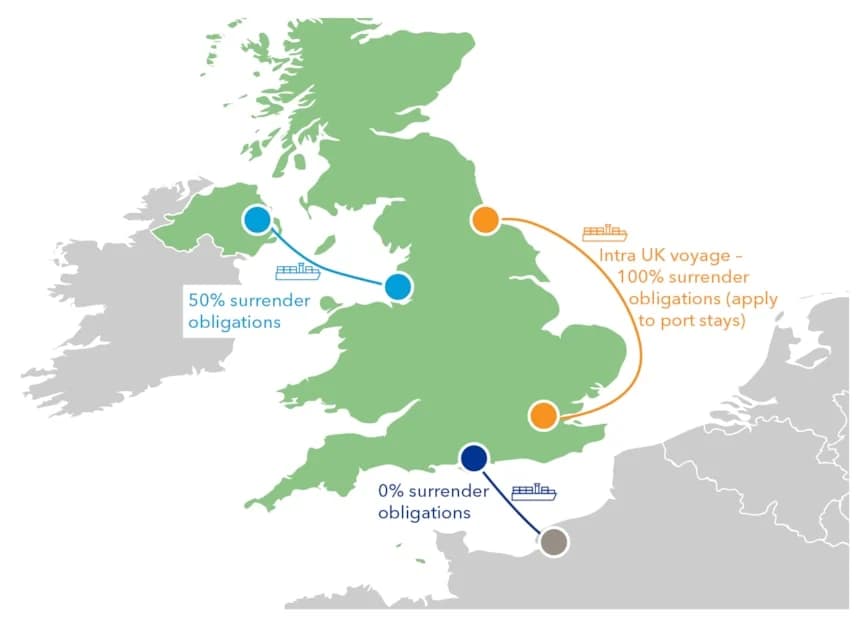
From 1 July 2026, the UK ETS applies to cargo and passenger vessels of 5,000 GT and above operating domestic UK voyages. The UK ETS introduces a company‑level compliance framework, including monitoring, reporting and verification. Ship operators must have an approved Emissions Monitoring Plan (EMP). Approval can be applied for at any time, but not later than 42 days after carrying out a maritime activity.
All submissions and approvals will be handled digitally through the METS platform and UK ETS Registry. Revocation of UK MRV as of 3 April 2026, with remaining verification obligations and transition to UK ETS from 1 July 2026.
UK ETS scope and compliance cycle As of 1 July 2026, the UK ETS applies to cargo and passenger vessels of 5,000 GT and above, with the inclusion of offshore ships delayed until 1 January 2027. The scheme covers emissions from domestic voyages between UK ports. A domestic voyage includes voyages from one UK port to another, as well as voyages that start and end at the same UK port. In addition, emissions generated during ports of call are within scope, including time spent at berth, whether moored or anchored, at UK ports and offshore installations.
Ship operators are required to monitor and report emissions occurring in UK ports and on domestic UK voyages. As a result, emissions from ports of call on international routes are also captured under the UK ETS. The greenhouse gases covered are aligned with those under the EU ETS and include emissions from combustion and slippage of carbon dioxide (CO₂), methane (CH₄) and nitrous oxide (N₂O), calculated on a tank‑to‑wake basis. Methane and nitrous oxide are reported using IPCC AR5 global warming potential values (CH₄ = 28, N₂O = 265).
← Back to News & Insights